When I pause and reflect on who I am, I see the many roles I hold — daughter, mother, sister, friend.
Each one expresses a part of my heart, yet none of them take away from the truth:
I am still me.
In a holy and far more perfect way, God reveals Himself to us.
🌸 Father — covering us with love
🌸 Son — walking beside us as Saviour and Friend
🌸 Holy Spirit — dwelling within us as Comforter and Guide
Three expressions of His heart.
Three ways He pours out His presence.
Yet still one God — whole, complete, and everlasting.
A sacred mystery, a beautiful truth:
God is Triune, and God is One.
━━━━━━━━━━━━━━━━━━
As I walk forward, remind me that I never walk alone.
Let Your truth settle deeply in my heart:
🌿 Father over me
🌿 Saviour beside me
🌿 Spirit within me
Holiness is a word that often carries mixed meanings. Sometimes we hear it said with sarcasm: “Oh, you think you’re so holy.” Other times, it’s spoken with admiration: “They’re such a lovely person — very holy.”
But beyond opinions, assumptions, and stereotypes lies a deeply biblical word rich with beauty and meaning.
So, what does it really mean to be holy?
1. Holiness Means Being “Set Apart”
The Bible’s words for holy — qadosh (Hebrew) and hagios (Greek) — literally mean:
set apart, distinct, different in nature and purpose.
Scripture makes this clear:
• “…Holy, holy, holy is the Lord Almighty…” Isaiah 6:3 NIV
• “For I am the Lord your God. You must consecrate yourselves and be holy, because I am holy…” Leviticus 11:44 NLT
God is holy because God is utterly unique: perfectly pure, perfectly good, perfectly loving.
And yet God calls us into that holiness.
2. Holiness Is Relationship Before Behaviour
Before holiness is something we do, it is something God gives.
• “Now may the God of peace make you holy in every way…” 1 Thessalonians 5:23 NLT
• “… I am writing to all of God’s holy people in Philippi who belong to Christ Jesus …” Philippians 1:1 NLT
Holiness begins not with perfection or effort, but with belonging to God.
We are set apart because He calls us His own.
3. Holiness Is Transformation, Not Perfection
Holiness is not a performance — it’s a process.
It is God reshaping our desires, habits, and character to reflect His nature.
• “Do not conform yourselves to the standards of this world, but let God transform you inwardly by a complete change of your mind…” Romans 12:2 GNT
• “But I say, walk by the Spirit, and you will not gratify the desires of the flesh” Galatians 5:16 ESV
Holiness is God working in us, expressed through the choices we make each day.
4. Holiness in Community
While holiness is deeply personal, it is never meant to be private. Scripture consistently shows that God forms a holy people, not just holy individuals.
• “…You are a chosen people. a holy nation, God’s very own possession…” 1 Peter 2:9 NLT
• “Make every effort to keep yourselves united in the Spirit, binding yourselves together with peace” Ephesians 4:3 NLT
Holiness is not about withdrawing from the world, nor is it about achieving flawless behaviour. It is about allowing God to shape who we are from the inside out. When we understand holiness as belonging to God and reflecting His character in everyday life, it becomes less of a burden and more of a beautiful invitation.
To be holy is to say, “Lord, set me apart for Your purposes.”
It is to choose God’s ways even when they run against the grain of what is normal or expected.
It is to live in a way that points others toward the One who transforms hearts.
Holiness is not something we attain by striving — it is something we receive by grace and cultivate through obedience. As God works His holiness in us, we become people who shine His light, carry His compassion, speak His truth, and display His love in a world that desperately needs it.
Holiness is a journey.
Holiness is a calling.
Holiness is a gift.
And above all, holiness is a reflection of the God who has called us His own.
“Jesus Christ is the same yesterday, today, and forever.” Hebrews 13:8 NLT
This verse highlights a foundational truth about God’s nature: His immutability — the fact that He never changes. Unlike humans, who waver in emotion, decision, and character, God remains absolutely consistent. What God has said He will do is exactly what He will do; what He has declared He will not do; He will not do.
His forgiveness does not negate His firmness. His grace does not dilute His truth. Scripture provides the reliable framework for understanding how God responds, acts, and leads. Because His character is constant, believers can place complete confidence in His promises.
YHWH
God replied to Moses, “I AM WHO I AM. Say this to the people of Israel: I AM has sent me to you” (Exodus 3:14-15 NLT)
The Lord, the most sacred name of God
El (Genesis 33:20) - “Mighty One”
A simple yet profound title highlighting God’s strength and supremacy.
El Shaddai (Genesis 17:1) - “God Almighty” or “All-Sufficient One”
Reveals God’s ability to supply every need and His absolute power over all things.
El Elyon (Genesis 14:18)
“God Most High”
Declares God’s exalted position above all creation and His sovereignty over heaven and earth.
El Roi (Genesis 16:13)
“God Who Sees”
ELOHIM (Genesis 1:1)
“God, Mighty Creator”
Adonai (Genesis 33:20)
“Lord, Master”
EL-ELOHE-ISRAEL (Genesis 33:20)
“God, the God of Israel”
EL OLAM (Genesis 21:33)
“Everlasting God”
Abba Father (Romans 8:15)
“Dear Father” or “Daddy”
Jehovah Sabaoth (1 Samuel 1:3)
“The Lord of Hosts”
Jehovah Jireh (Genesis 22:14)
“The Lord Will Provide”
Jehovah Rapha (Exodus 15:26)
“The Lord Who Heals”
Jehovah Mekoddishkem (Exodus 31:13)
“The Lord Who Sanctifies”
Jehovah Shalom (Judges 6:24)
“The Lord Is Peace”
Jehovah Shammah (Ezekiel 48:35)
“The Lord Is There”
Jehovah Nissi (Exodus 17:15)
“The Lord Is My Banner”
Jehovah Tsidkenu (Jeremiah 23:6)
“The Lord Our Righteousness”
Jehovah Rohi (Psalm 23)
“The Lord is My Shepherd”
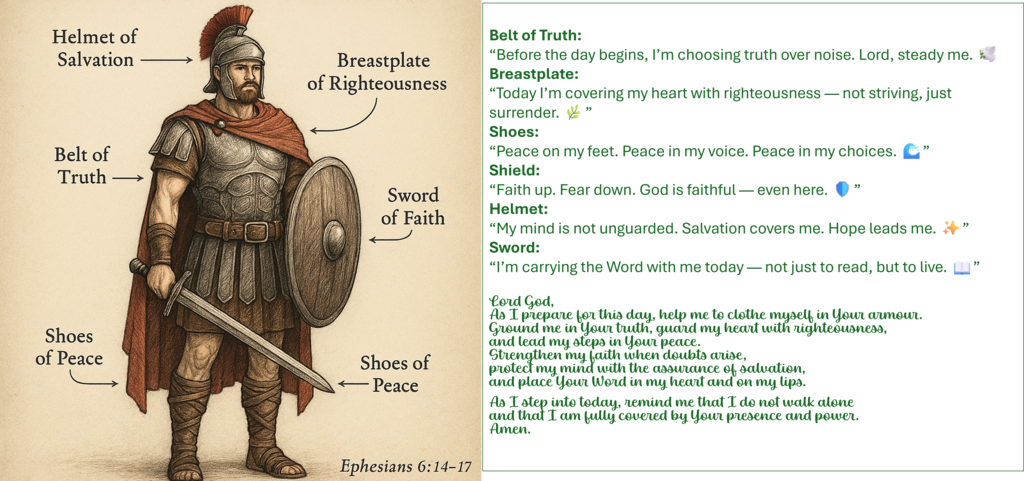
Putting On the Armour of God: A Daily Choice
Most of us get dressed each morning without much thought. We put on the basics first, layer by layer, until we’re ready to step into the day. Scripture invites us to approach our spiritual lives in much the same way.
In Ephesians 6, we are encouraged to “put on the full armour of God.” This isn’t about preparing for extraordinary moments only, but about being spiritually dressed for ordinary, everyday life.
Think of the armour of God as what you put on each morning before you face the world.
You begin with the belt of truth. Just as underwear is the first essential layer—unseen but vital—the truth of God is what holds everything else together. Before anyone else sees us, we ground ourselves in what is true: who God is, who we are in Him, and what He says about our lives.
Next comes the breastplate of righteousness, like your shirt or blouse. It covers your core and protects your heart. When you clothe yourself in righteousness, you are choosing to live from your identity in Christ, not from guilt, shame, or the need to prove yourself.
Then you put on your shoes, the shoes of peace. Shoes prepare you to move, to walk confidently into whatever the day brings. God’s peace steadies us, helping us respond rather than react, and carry calm into places that feel unsettled.
Over everything, you take up the shield of faith, like a jacket or coat you grab before heading out. Faith protects you from the unexpected—doubt, fear, criticism, or discouragement. It reminds you that God is faithful even when circumstances are uncertain.
You place the helmet of salvation on your head, much like a hat or head covering that protects your mind. Salvation guards your thoughts, reminding you that you belong to God and that your future is secure in Him.
Finally, you carry the sword of the Spirit, the Word of God. Just as we take our phone or keys with us when we leave the house, God’s Word equips us to respond wisely, speak truth, and stand firm when challenges arise.
Putting on the armour of God is not a once‑off event. It is a daily, intentional choice. Each morning is an invitation to clothe ourselves in God’s truth, peace, faith, and strength before stepping into the demands of the day.
A Simple Call to Action
Tomorrow morning, as you get dressed, pause for a moment. With each item of clothing you put on, ask God to help you put on the corresponding piece of His armour. Invite Him into your day before it begins.
Stand dressed. Stand ready. And walk forward knowing you are fully covered.
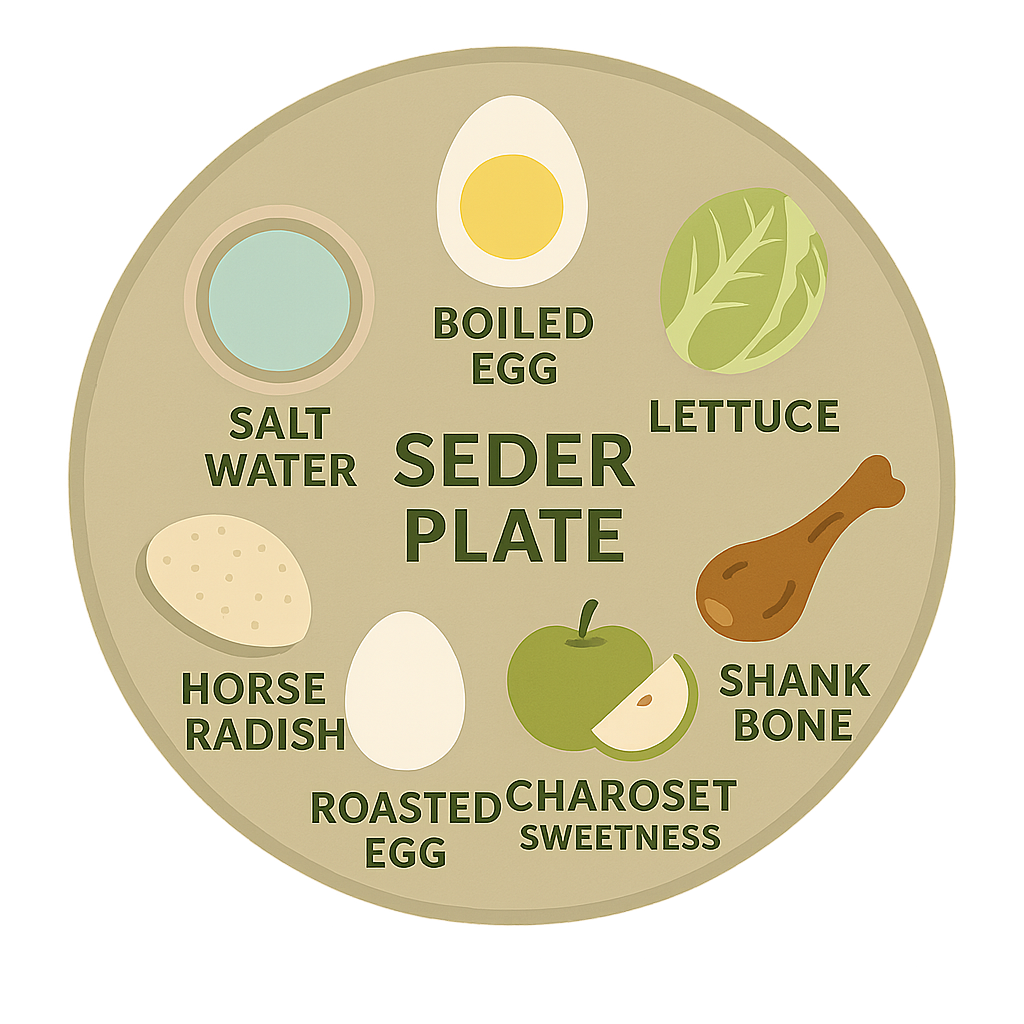
The Seder Plate
Symbols Of Deliverance And Devotion
Each item on the Seder plate tells a story — not just of ancient Israel, but of the God who still delivers, still redeems, and still walks with us through every season. As Christians, we see Christ reflected in each symbol, and we receive the invitation to remember, rejoice, and rest in His mercy.